01 · Fleet recovery
Turn small tanks into measurable volume.
Passenger cars, service vans and light fleets become a serious case when consumption is measured across the whole population.

Light-duty fuel is fragmented, but the volume is enormous. NTROPYX separates petrol and diesel profiles so fleets see real litres, refill intervals and net operating cost.
Immediate message: fuel efficiency, cleaner combustion, lower waste and a commercial path sized to the sector.
Passenger cars, service vans and light fleets become a serious case when consumption is measured across the whole population.
NTROPYX communication stays disciplined: each fuel profile is modelled by consumption, distance and operating use.
The visitor sees the business case in familiar fleet language: litres, refill interval, net cost and scalable recovery.
European Commission OBFCM data for 2021-registered cars reports real-world fuel use of 7.89 L/100 km for petrol and 6.88 L/100 km for diesel. Combined petrol + diesel: 7.44 L/100 km, with a 21.2% average gap versus WLTP. Switzerland adds a dense installed base: about 4.76 million passenger cars, still mainly petrol and diesel, with average annual mileage around 12 500 km.
European average petrol pump price, taxes included, week of , published by the European Commission. +23.7% versus WLTP. Derivation: European Commission COM(2024)122, Table 3, cars registered in 2021 with OBFCM real-world readings: petrol 7.89 L/100 km, diesel 6.88 L/100 km, petrol + diesel 7.44 L/100 km.
Sources · European Commission COM(2024)122, Table 3, OBFCM real-world fuel consumption for cars. · Eurostat Complete Energy Balances [nrg_bal_c] — query FC_TRA_ROAD_E × O4652XR5210B (motor gasoline) + O4671XR5220B (gas oil & diesel), TJ, 2023. Conversion: gasoline 32 MJ/L, diesel 36 MJ/L. · Switzerland: Avenergy Suisse press release 22.03.2024 — ~6.13 Bn L road fuel, petrol + diesel. · ACEA Vehicles in use, Europe 2023 for EU passenger-car fleet scale. · Switzerland passenger-car exposure remains indicative: FSO/FEDRO vehicle stock by fuel and BFE average mileage.
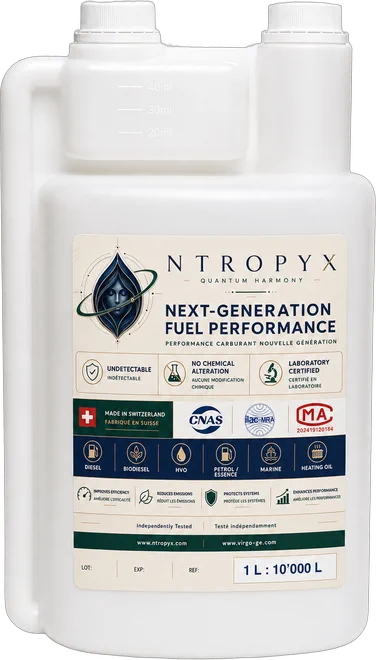
1 L bottle · standard concentration. One litre treats 10 000 litres of petrol and diesel.